press - articles / reprints

Nelson-Atkins Museum of Art - Architectural Record


Article from Architectural Record - July 2007
To download the PDF, right click here and save as.


Steven Holl Architects merges architecture, art, and landscape into a unified experience for the Bloch Building at the NELSON-ATKINS MUSEUM OF ART in Kansas City

By Suzanne Stephens

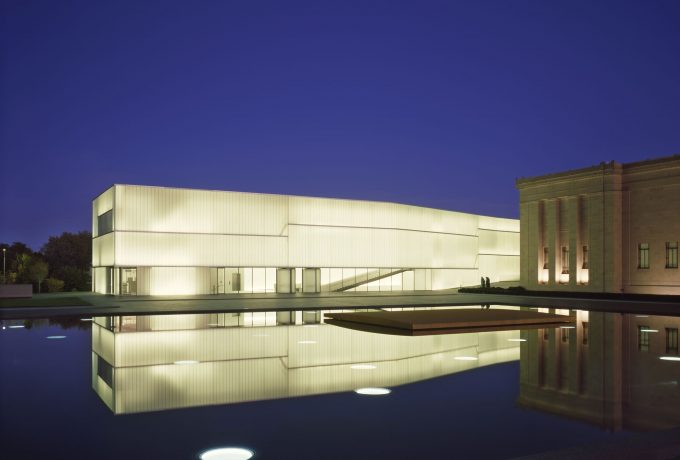
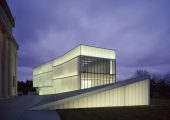
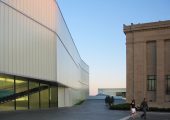
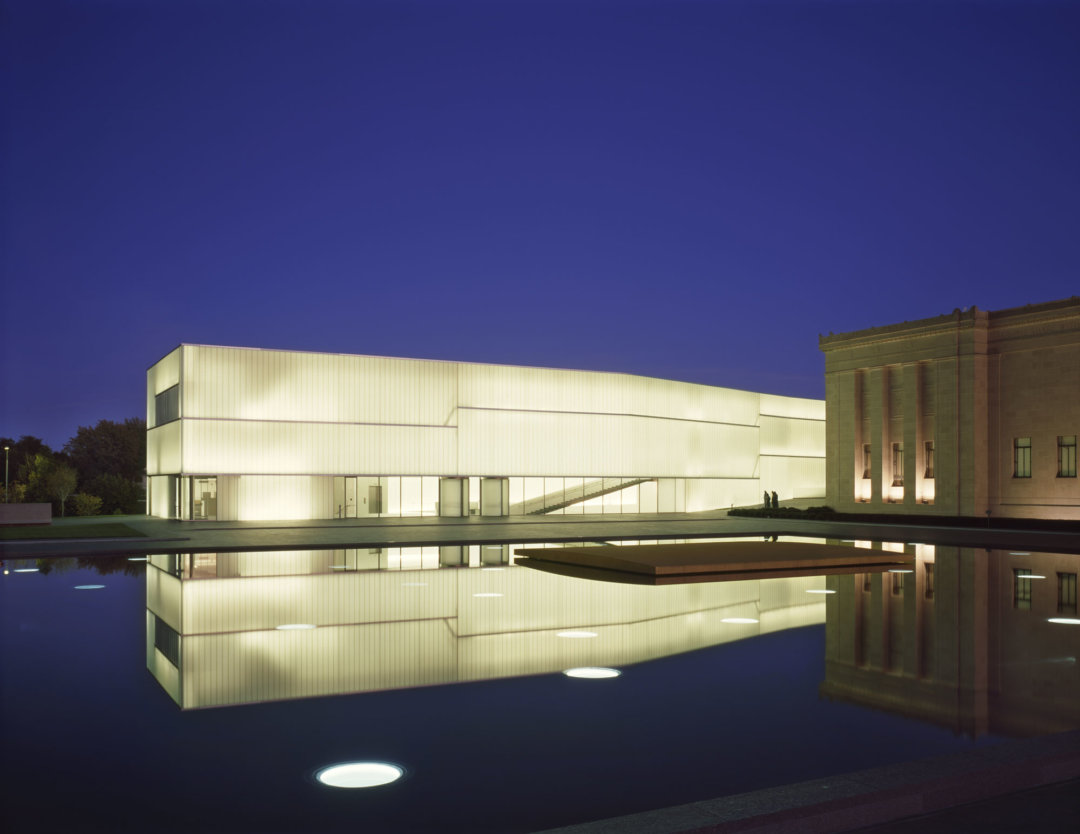
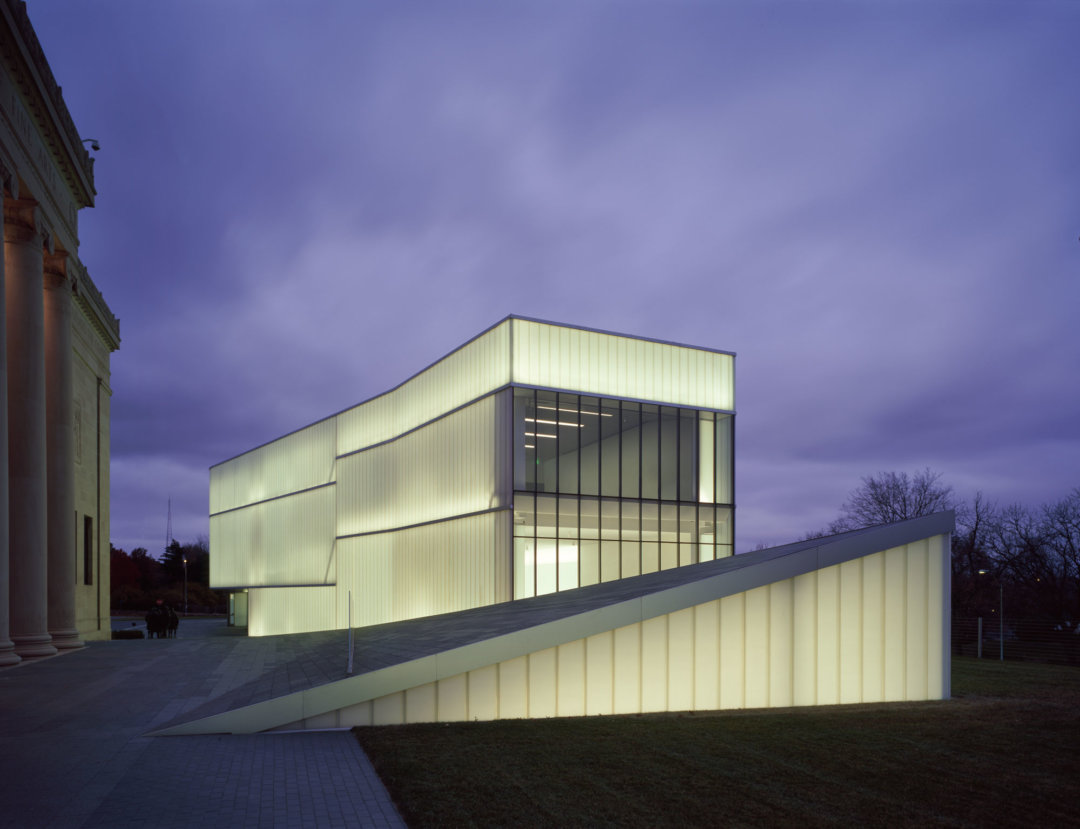
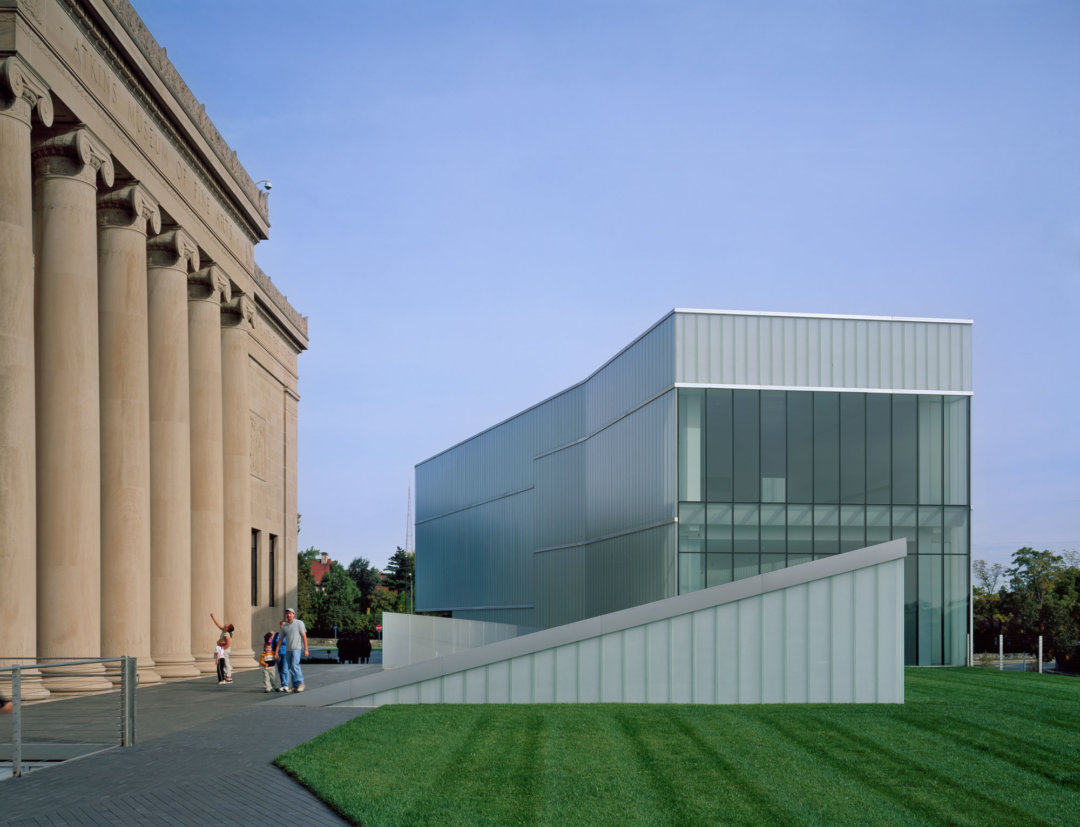
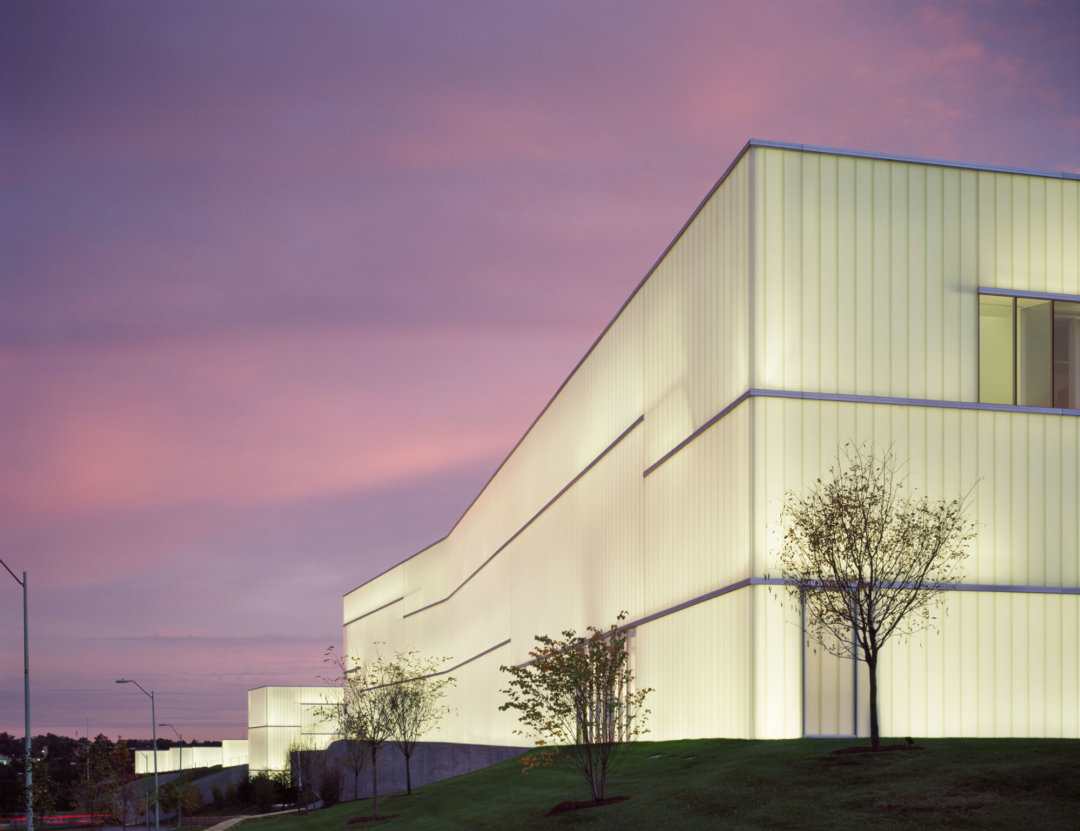
During construction, the reaction to the Nelson-Atkins Museum's Bloch Building ran the gamut from irascible to irate. According to the museum's intrepid director, Marc Wilson, the Kansas City public had liked Steven Holl Architects' design well enough when viewing it as an architectural model. "But all models are tine," Wilson explains. It was another thing when the citizenry got a glimpse of the channel-glass-clad structures, coming out of the muddy turf atop the 840-foor-long linear underground galleries. Winding down the eastern slope, hard by the classically styled main building, all five polyhedral forms looked like so many icebergs threatening to sink the Titanically proportioned limestone building designed in 1933 by Wight and Wight.

Observers dismissed Holl's "lenses," as he calls the irregularly shaped geometric light monitors, as shipping containers. Such ire reportedly unnerved even the new building's lead donor, Henry Bloch (founder of H&R Block), for whom the 165,599-square-foot addition is named.

Now Holl and Wilson can feel fully vindicated. The building opened in early June with great fanfare and overwhelmingly adulatory press. Steven Holl, AIA, his partner Chris McVoy, and the local architects Berkebile, Nelson, Immenschuh, McDowell (BNIM), under the leadership of Casey Cassias, AIA, can now rightfully enjoy the credit due after eight years of grueling effort.

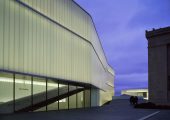
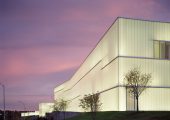
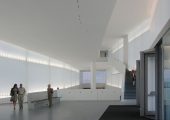
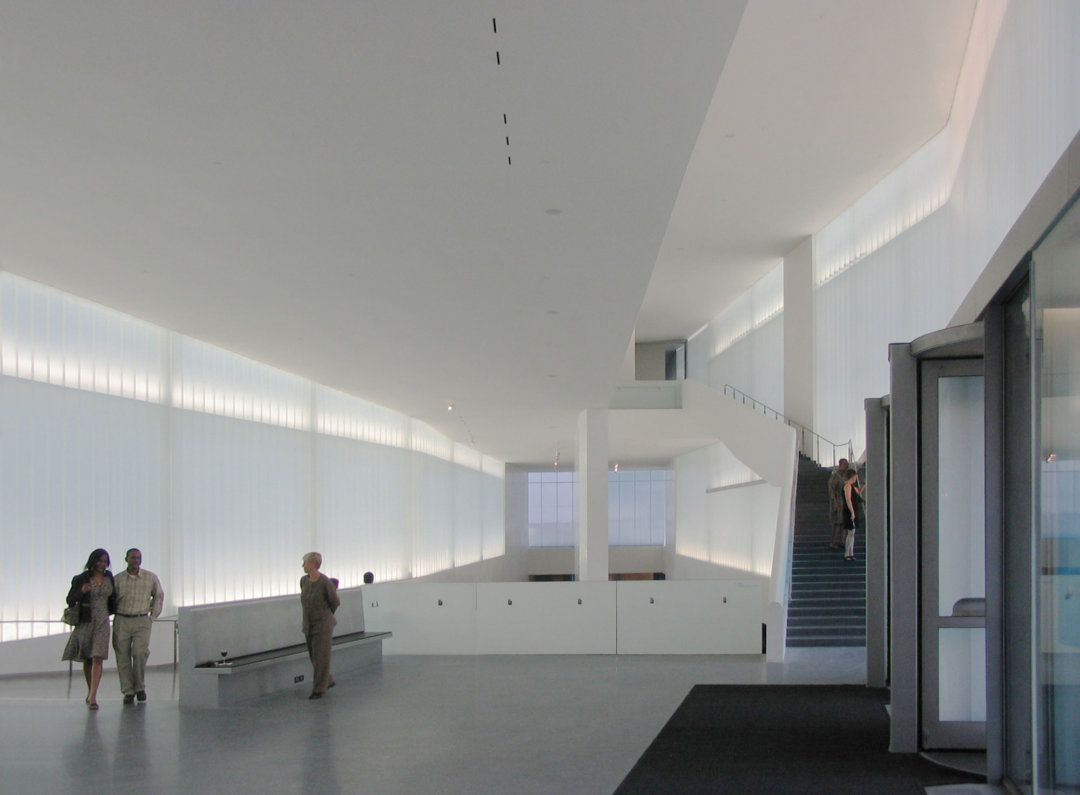
True, museums usually enjoy an intense if too brief honeymoon when they first open. This is before leaks occur, or before visitors and curators start to complain that the architectural extravaganza overwhelms the art. For now, not even a storm has blown in to test the claim that the glass can withstand winds up to 135 miles an hour. On top of that, the permanent collection of contemporary art fits in to the spaces smoothly and strikingly. And while neighborhood residents thought the shipping containers didn't quite fit in with the symmetrical, Ionic-columned temple of art, the lenses, luminous with interior lighting at night, glinting in the sun by day, are looking a lot better amid the 50,000 square feet of grass-planted walls with curved tops, bounce light softly down from clerestories, an effect that seems to owe much to the scupperlike light monitors of Josep Lluis Sert's Fondation Maeght in Saint-Paul de Vence, France (1964), as well as the slotted barrel vaults of Louis Kahn's Kimbell Art Museum, in Fort Worth (1972). Secondary concave projections (called "flutters"), which resemble giant abstractly rendered acanthus leaves, refract light as well.

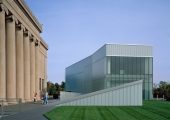
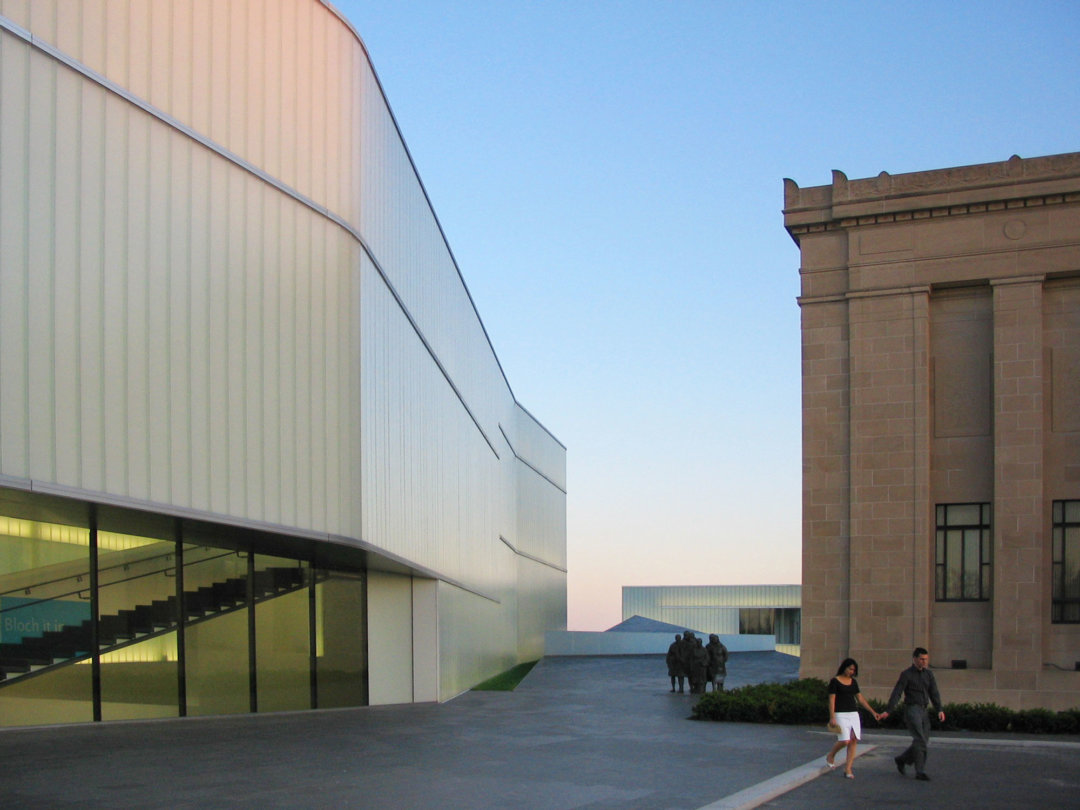
The 22-acre Kansas City Sculpture Park, designed in 1989 by landscape architect Dan Kiley and Jaquelin Robertson of Cooper Robertson, lies to the south of the old museum (right). Part of a public/private enterprise between the museum, the city, and the Hall Family Foundation, the park merges with the grassy lawn and roofs of the new wing.

Project: Bloch Building, Nelson-Atkins Museum of Art, Kansas City, Mo.
Architect: Steven Holl
Architects - Steven Holl, AIA principal; Chris McVoy, partner in charge; Martin Cox, Richard Tobias, project architects
Architect of record: Berkebile, Nelson, Immenschuh, McDowell (BNIM) ñ Casey Cassias, AIA, principal; Greg Sheldon, AIA, senior project architect; Matthew Porreca, AIA, Rick Schladweiler, AIA, project architects
Structural engineer: Guy Nordenson and Associates

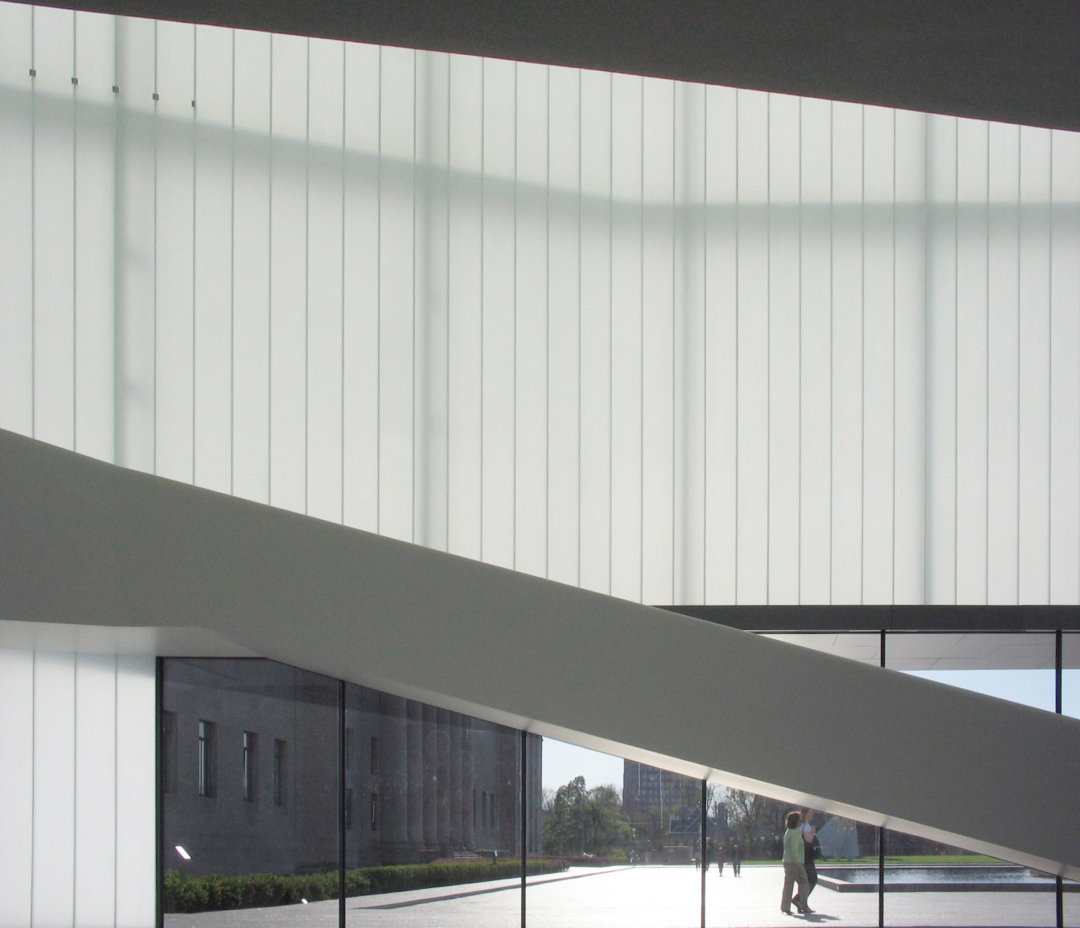
Farther along the gallery walk, you come to the Noguchi Court, where an expansive window wall looks out on the lushly terraced 22-acre Kansas City Sculpture Park, occupying the south lawn of the museum. Here Holl generated a strong visual connection to the outside through a swath of rocks that extends from the Noguchi Court's interior straight through the window was to as outside court. (Doors also offer access outside as well as in - as they do in many places in this admission-free museum).

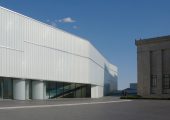
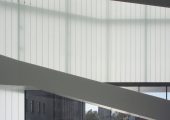
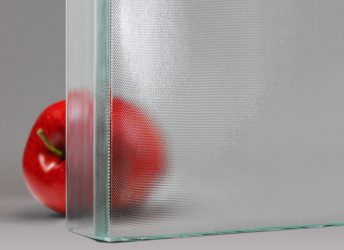
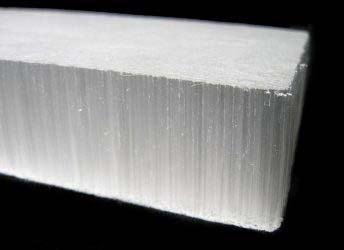
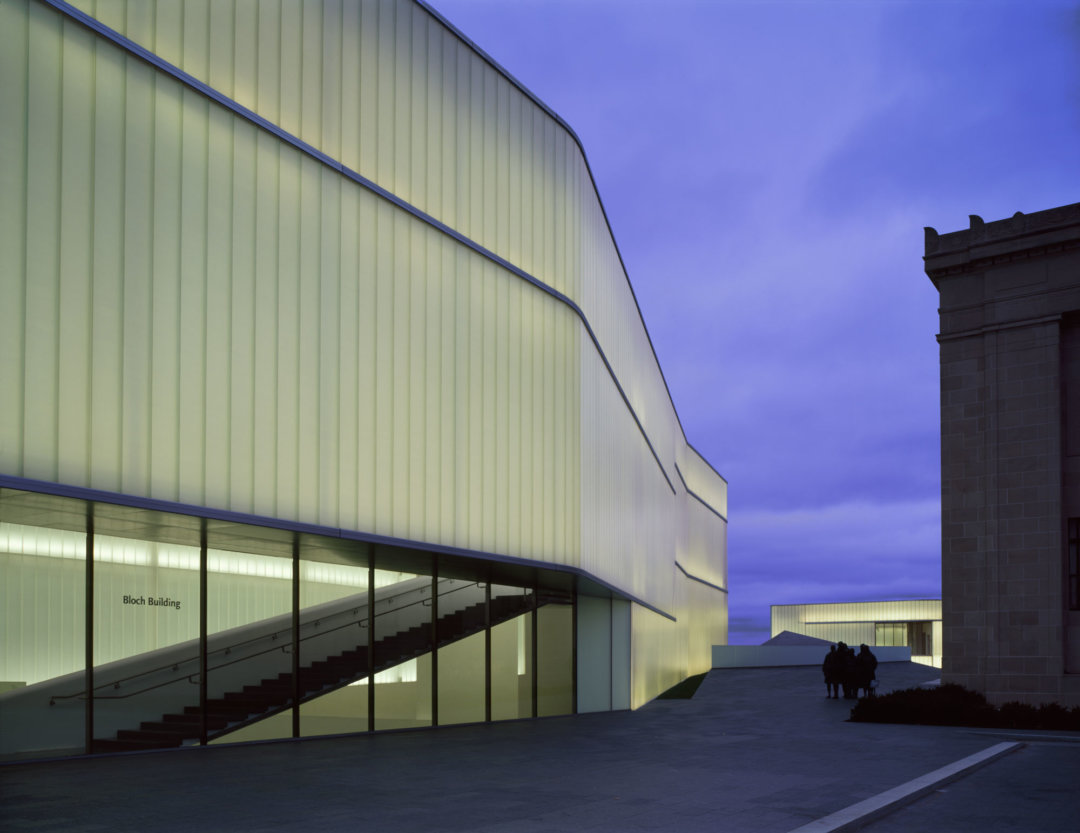
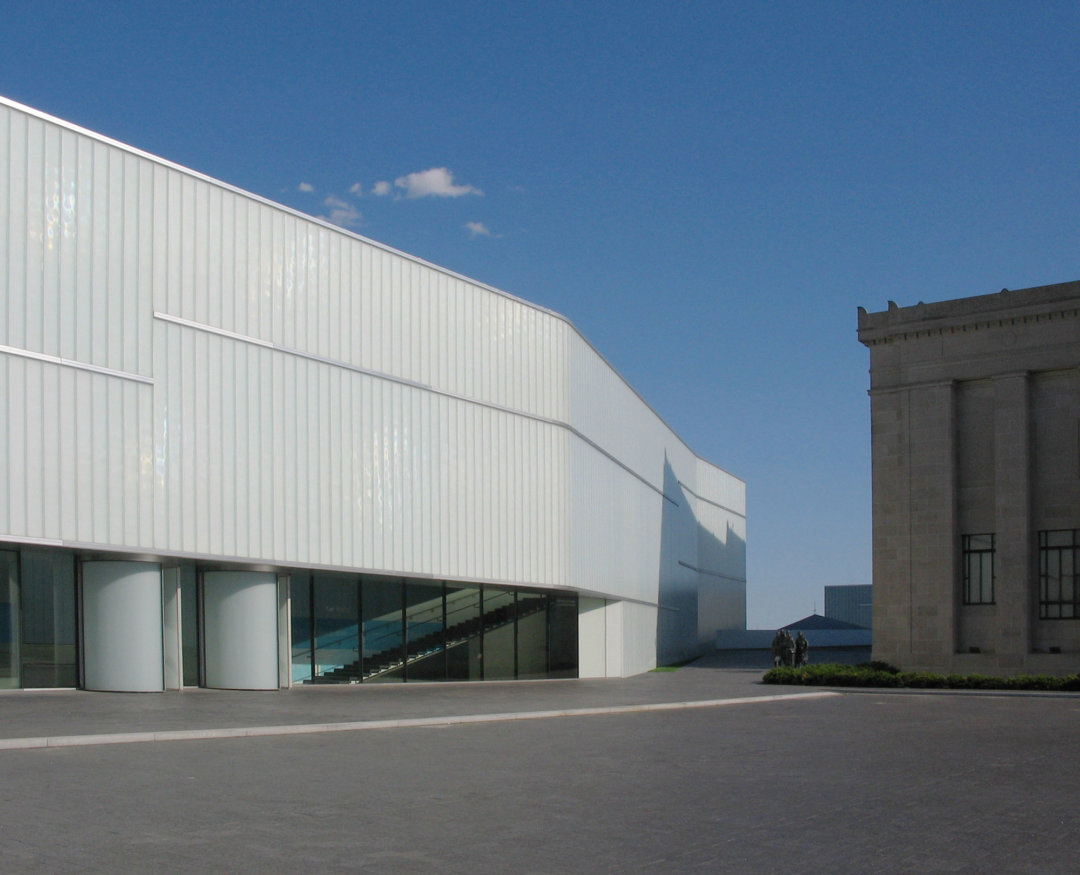
The Noguchi Court forms something of a terminus for the processional, although galleries for changing exhibitions lie beyond in lens five. Leaving the building to walk around the exterior of the lenses, you notice the sometimes low-key, sometimes dramatic interplay of light on channel-glass walls at various perspectives and during various times of the day. The cladding, composed of 6,000 double-interlocked U-profile planks of tempered low-iron glass, 16 inches wide, contains translucent capillary insulation between its inner and outer surfaces. This wall is separated from a single layer of acid-etched, low-iron, high-UV laminated glass by a 3-foot-wide catwalk accessible to service personnel. Fluorescent tubes places within the pressurized air cavity illuminate the structures at night.

Owing to a solar texture on the outer surface of the channel glass and the sandblasted inner face of this outer wall, the exterior takes on an opalescent sheen in sunlight, rather like chantung silk. Although it sometimes appears flat in even light, as exterior conditions change, a glinting moirÈ pattern emerges. While vertical joints composed of silicone tubes and sealants disappear from view, Holl designed the aluminum sills and headers for the planks as staggered horizontal lines: He didn't want them to read as edges of the floor plates, but to reaffirm the overall asymmetrical theme.

The asymmetrical addition doesn't look as if it was simple to build. And it wasn't. Some 650 drawings were needed, not including 300 perspectives to predict vantage points of museumgoers. Although the construction figure is given as $94 million, the overall budget, which includes a comprehensive restoration of the existing Nelson-Atkins by BNIM, plus a parking garage, came to $200 million.

The addition sits on poured-in-place concrete foundations. The level under the galleries is devoted to storage and loading docks. To keep the glass walls free of columns. Holl, in consultation with structural; engineer Guy Nordenson, worked out a steel framing system that pushes the structure to the center. In the first lens, a large truss snakes across the length of the space, like an asymmetrical spine. Holl, McVoy, and the team have exposed the truss elements at the top so that part of the structure could be legible. From the truss, part of the roof cantilever west over the glass window wall, which is suspended from it. The basic structure of the lenses for galleries is contained within T-wall units, which are thick enough to carry mechanical and electrical services. In these T-walls, a series of vertical trusses branch out as horizontal girders supporting the rood or an upper floor. The team stabilized this cantilevered structure by embedding rods in the channel glass's cavity walls, like cables and ropes on a boat.

Clearly, the museum's trustees and selection committee took a risk with Holl's innovative and structurally ambitious scheme. That the Nelson-Atkins was already famous for its collection of Chinese art gave them confidence ñ the museum didn't depend on architecture as the only draw. At the same time, Marc Wilson had been at the museum long enough ñ 34 years, including 25 as the director ñ to know the city, the public, and the donors all extremely well and to be able to handle controversy. Holl, who had daringly gone against the grain to place the addition to the east of the museum, when his competitors generally put their schemes in front of the north faÁade, won the backing of sophisticated selection committee in 1999, which included the late J. Carter Brown, William Lacy, and Ada Louise Huxtable.

Nevertheless, a laundry list of complaints could crop up: Illuminating five buildings at night is not very "green"; the silicone joints may fail long before the glass; and the rest of the Bloch Building needs a lot of glass cleaner and floor polish. Clearly, the old building and the new have little contextual relation ñ Holl's inspiration comes from the landforms and sculpture of the south lawn. In this case, the contradiction between the 1933 and the 2007 architecture works, but only through embracing antinomy: light to solid masses; asymmetrical to symmetrical plans; fragmented, nonhierarchical to centralized and hierarchical spaces.

Furthermore, there are no places for an indoor Richard Serra (this era's measuring stick for gallery sizes). Indeed, the ration of new circulation space to new gallery space seems about 50:50, so that the museum could run out of places to install art. While the art-free first lens offers a "party hall, "so necessary when staging exhibition openings, one could argue that the central Kirkwood Hall of the 1933 building provides a very elegant space for just this sort of thing. All of which is to say that, while this addition is brilliant ñ succeeding provocatively and magnificently in the integration of art, landscape, and architecture, of contract, contradiction, and dissonance,; of architecture raised to an artistic level ñ it is not a solution for every museum. It is unique in the true sense of the term.